Florida has many different kinds of pests, best known being the mosquitos and the roaches. Lesser known (but just as prevalent) are the many different kinds of ants Florida tends to have. When moving to Florida, many don’t consider ant infestations one of the bigger problems they made face. There are nine main types of ants that are found around Florida.


Carpenter Ants

Large reddish-black ants that tend to tunnel through wood to create nest, though they don’t eat it. They are commonly seen without wings, but if they are, it can indicate a swarm nearby. Carpenter ants primarily feed on insect honeydew, plant juices, and other insects, but will also eat sweets, grease, and other food found in your home. A rustling or crinkling sound from within walls or wood can signal a nest.


Red Imported Fire Ants

Red Imported Fire Ants are ants that are invasive ant species native to South America that has become a significant pest in the southern United States and other parts of the world. These reddish-brown ants build dome like mounds in sunny open areas and are known to aggressively defend their nests and attack or sting in large numbers. When they sting, their venom can cause anaphylaxis if the person stung has an allergy. They feed on crops like corn and soybeans and are known to make impacts to native wildlife as well as cost a lot of economic damages with the treatments needed for crops as well as ruined batches if needed.


Ghost Ants

They are bi-colored, with a dark brown or black head and thorax and a milky white or translucent gaster (abdomen), legs, and antennae. When crushed, they emit a distinctive, foul, coconut-like odor. Workers are extremely small, about 1.3 to 1.5 mm in length. These ants prefer warm, humid locations both indoors and outdoors. Indoors, they nest in wall voids, behind cabinets, and in baseboards. Preferring outdoors, they nest in soil, under debris, and in plant cavities. Colonies can be moderate to large and may have multiple nests, making them hard to track and eliminate. They primarily feed on sweet substances, greasy foods, and other insects like aphids. 


Argentine Ants

They are small, about 2–3 mm long, and light to dark brown. These ants form long trails and can be found in large numbers. They build shallow nests in moist areas under objects like rocks, mulch, and logs. Their diet is general and includes sweets, insects, seeds, and honeydew. They can bite but do not have a stinger. When crushed, the bigger ants emit a faint musty odor. Argentine ants are highly aggressive towards other ant species, outcompeting them for resources and leading to declines in native populations. They negatively impact plants by neglecting the dispersal and protection of seeds that native ants once cared for. 

Pharaoh Ants

These ants are light yellow to reddish, with darker markings on the abdomen and have a smooth appearance and a distinct, club-shaped antennae. Preferring warm, humid, and dark places, frequently nesting inside wall voids, behind baseboards, under floors, and in electrical outlets. They are omnivorous, feeding on sweets, fats, proteins, and dead insects. They are known to infest food and can also be attracted to things like medical bandages. Pharoah ants can travel long distances through pipes, wires, and utility lines, allowing them to spread throughout entire buildings. 

Tawny Crazy Ants

The ant is about 3 mm (or about 1/8 inches) long, thus smaller than the red imported fire ants. It is covered with reddish-brown hairs. Their larvae are plump and hairy, with a specific conformation of mouthparts and unique mandible morphology that allows for precise species identification. The colonies live under stones or piles; they have no centralized nests, beds, or mounds. They tend aphids for honeydew, feed on small insects and vertebrates, and forage on plants, especially for sweet materials. The ants appear to prefer the warmth and moisture of the coast.


White-Footed Ants

Their appearance is black to brownish-black ants with yellowish-white feet and a single-segmented waist with small, with a body length of about 2.5-3 mm. They form steady, persistent trails, often following scent trails along walls or trees to find food. Nests are commonly found under leaves, in loose mulch, under debris, in tree holes, and under palm fronds. They frequently nest inside homes in wall voids, attics, and behind siding or brick. Colonies can be very large and interconnected, with multiple satellite nests that make them difficult to eliminate. 


Pavement Ants

The species is commonly known as the “pavement ant” because workers are commonly found in pavements or roads, usually searching for food. There’s not much known about these ants.


Odorous House Ants

Uniformly brown to black, the workers are about 1/16 to 1/8 inch long. A strong, rotten coconut-like smell is released when they are crushed. These ants are monomorphic (all workers are about the same size), 12-segmented antennae without a club, and an uneven thorax. They enter homes in search of food and water, are often found near moisture sources, in wall voids near pipes, or in kitchens and food storage areas, and colonies can be large, sometimes numbering from 100 to 10,000 ants both indoors and outdoors. 

Expert Insight:

Written by a licensed pest control professional with hands-on experience serving residential and commercial properties in Citrus County Florida, supported by consistent positive customer reviews on Google.

If you are having trouble with ants or any other pests, call Turbo Pest Solutions at (352) 345-7572

Mud tubes left by termites

Hi there. I’m in The Villages Florida at one of our chiropractor’s offices and I want to kind of show you guys some things about IPM. IPM is integrated pest management. So what that means is when we’re going into a facility like a chiropractor’s office or something similar, we don’t want to be spraying all over the place just because of the nature of what the services they provide there. So when we go there, we use our eyes and different monitoring systems so we can look for the why of why any pests are getting in or get ahead of any kind of pests that might enter the building.

So, I’m going to turn the camera around and I’m going to kind of walk around with you for a second and show you a couple of things that we would look for. Okay, so first thing that I noticed when I come in is that we have a small gap under the door there. We have light getting through. So that means a pest are going to get through. So what we would do is we  would spot treat at those entrances like that and advise the owners to seal those up and like with some weather stripping or anything like that. And if we take a walk up to the front, stay with me, we can get to the front and we see that we also have the same gap up front. we have the light getting through and we would also advise them that this, you know, this is a shared building. So, we know that there are other buildings and other access points that we can’t control.

Expert Insight:

Written by a licensed pest control professional with hands-on experience serving residential and commercial properties in Citrus County Florida, supported by consistent positive customer reviews on Google.

If you are having trouble with ants or any other pests, call Turbo Pest Solutions at (352) 345-7572

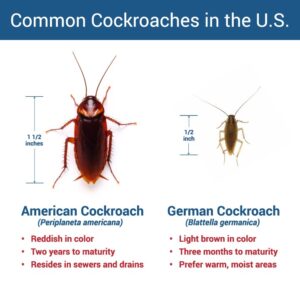
German roaches are a pest people never want to find in their home, though can be said about almost every pest. It’s one of the most common kind of roach to see in homes (especially hot and humid areas like Florida).  What makes these pests different is German roaches are what some call a “domesticated pest”. A pest meant to live with humans. These roaches are almost bred to live in human conditions rather than outdoors. An infestation is not a sign that someone is dirty or even has a dirty home.

They spread almost like a common cold, going from one person to the next through things like bags, boxes and sometimes something as simple as an infested appliance being brought from one home to another. This has earned them the name “hitch-hiker pests” as well. When these pests find their way into your home they leave tale-tell signs of their intrusion.

If you’re having a pest problem, and need a solution, call Turbo Pest Solutions at (352)-345-7572

Signs to Look For

A sign to look out for is their droppings which tend to look like coffee grounds or black pepper. Longer established infestations tend to leave smear marks on walls and floors where they’ve been stepped on or walked through oils. Roaches tend to shed their skin as they grow. These skins are also big indicators that there is an infestation. They are found in tight spaces like drawers and under sinks where they thrive. They look for areas where its warm and wet, like behind stoves and dishwashers.

Another big sign of an infestation are dropped egg casings or “oothecas” which can contain around fifty eggs per capsule. These little grenades of roach babies can cause an infestation with a couple of them alone. Another important thing to watch out for is, obvious enough, dead roaches. Finding a lot of dead roaches in one place hidden, or especially more than a few dead out in the open can be reason to suspect an infestation. Roaches eat each other so lots of dead roaches is the equivalent of an open food source.

Other strong indicators of an already set in infestation are a musty odor, which is the pheromone that roaches let off. It’s not really comparable to another smell like sulfur or rotten eggs. Once you smell it you will know the smell for the rest of your days though. It’s best described as “musty” and almost greasy with a sickly sweet tang to it.

You’ll also see chew marks on food left out, books or even fabrics. The biggest indicator of an overcrowded infestation is seeing live roaches during the day considering they are nocturnal.

Prevention of Infestation

Roaches are commonly just doing what they can to stay alive, working purely on feral instinct. Once they’re in, it can be very difficult to get them out. Working before they are even there to keep them out can be a life saver if they ever do find their way in.

Making sure to repair holes in water pipes, baseboards, doors and windows is a huge help. Putting weather-strip and caulking any small cracks, holes and any areas they could use as highways through your home are very important. Putting screens over things like vents, windows and floor drains can prevent many pests from finding their way into your home, not just roaches.

Roaches tend to feed on anything they can get ahold of, so clearing your house of any un-needed cardboard, paper bags, newspaper, etc. can really help with not giving them a feast if they do find their way in. Keeping tidy, not leaving food out, and fixing leaky pipes are all very important. Remember though, a dirty or clean house are not the difference when it comes to an infestation. It’s the willingness to work at getting it fixed. Here at Turbo Pest Solutions we focus on eradicating the pest. Solving the problem and not just controlling it.

Expert Insight:

Written by a licensed pest control professional with hands-on experience serving residential and commercial properties in Citrus County Florida, supported by consistent positive customer reviews on Google.

If you are having trouble with ants or any other pests, call Turbo Pest Solutions at (352) 345-7572


Black Widows in Citrus County

Look at that red! This pretty girl was found in Citrus Springs FL! The most recognizable part of a black widow is their beautiful red hourglass that sticks out against their obsidian skin, but there are many misconceptions about these beauties!! For instance, I’m sure you’ve been advised to stay far away from this venomous spider, but did you know it’s only the females who have venom? You can tell the difference as females are that almost void black with the hourglass, and males which are more brown or gray with red spots.
Another fun fact, although they have eight eyes, they actually have really poor eyesight! They rely mostly on their webs and the vibrations to know what to do. Contrary to popular belief, black widows are not violent at all, the females actually only bite when they feel threatened or if they are protecting their eggs. Males are even less likely to bite and are rarely even seen considering they are often eaten after mating.
How fascinating!!

Expert Insight:

Written by a licensed pest control professional with hands-on experience serving residential and commercial properties in Citrus County Florida, supported by consistent positive customer reviews on Google.

If you are having trouble with ants or any other pests, call Turbo Pest Solutions at (352) 345-7572